

The 18.6-Year
Real Estate Cycle
Major peaks and troughs in the real estate market tend to repeat roughly every 18 to 19 years. Understanding this cycle can help buyers, sellers, and investors make better decisions at every stage of the market.
The real estate industry is known for being cyclical, with periods of boom and bust that can have a profound impact on the broader economy. One of the most studied patterns is the 18.6-year Real Estate Cycle, also known as the Land Cycle or Property Cycle. This cycle is based on the observation that major peaks and troughs in the real estate market tend to occur roughly every 18 to 19 years.
Understanding this cycle is valuable for investors, developers, and policymakers alike. It can provide meaningful insight into where the market is headed and help inform smarter investment decisions over the long term.
Why does the cycle repeat?
Several factors contribute to the real estate cycle, including economic, demographic, and policy-related influences. Interest rates, inflation, and employment levels affect demand for housing and the overall health of the market. Population growth, migration patterns, and changes in household composition shape what types of properties are in demand and where. Zoning regulations, tax policies, and government incentives affect both the supply side and the demand side of the equation.
The cycle repeats because of the fundamental interplay between supply and demand. During periods of economic growth and demographic expansion, demand for housing rises, prices increase, and construction accelerates. Over time, supply catches up to demand, prices level off, and construction slows. An oversupply eventually emerges, prices decline, and activity contracts. As prices bottom out and excess inventory is absorbed, the conditions for the next cycle begin to form.
The four phases of the real estate cycle
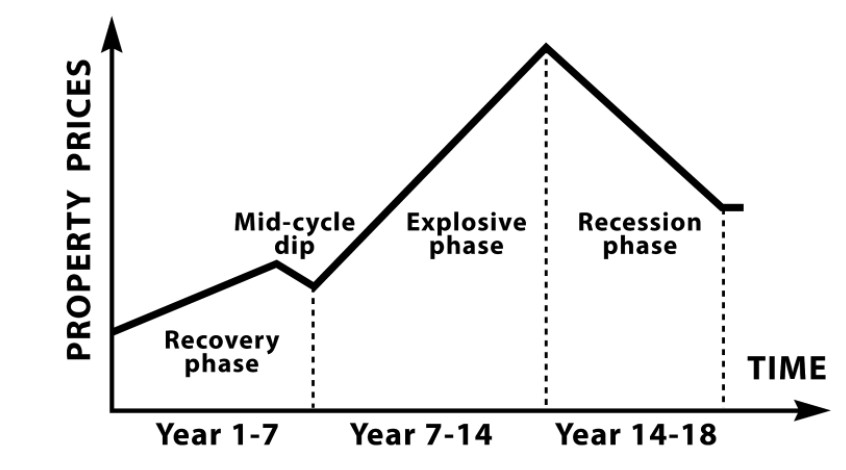
Each cycle moves through four distinct phases. Recognizing which phase the market is in at any given time is one of the most useful tools available to real estate investors and buyers.
Recovery
This stage occurs immediately after a market downturn and is characterized by low prices and limited construction activity. Property prices have fallen enough to attract investors drawn by high yields relative to low purchase prices, while rents remain healthy because people always need a place to live. Investors who recognize this phase early often find the most attractive acquisition opportunities.
Expansion
As the market recovers, demand increases, prices rise, and construction accelerates. Large companies and pension funds begin acquiring distressed portfolios. Prime assets in the most popular markets attract capital first, and growth then spreads outward. Developers invest in new projects with growing confidence in future returns.
Hyper-supply
Sustained construction activity eventually produces an oversupply of housing, causing prices to level off or soften. Competition increases for developers, and early investors begin exiting their positions. A slight mid-cycle dip is common during this phase as initial profit-taking occurs before the cycle reaches its ultimate peak.
Recession
If economic conditions deteriorate as oversupply builds, prices can decline sharply and construction activity contracts significantly. Economist Fred Harrison coined the term “winner’s curse” in his book Boom Bust to describe buyers who secured a property at peak competition, only to watch its value fall substantially as the next recession arrived sooner than expected.
Previous real estate cycles in the United States
The United States has moved through several well-documented real estate cycles. Studying these historical patterns reveals how consistently the forces of supply, demand, credit, and sentiment repeat themselves across generations.
The Roaring Twenties and the Great Crash
The rise of the automobile and the expansion of the middle class drove strong demand for housing throughout the 1920s. Construction activity and prices rose steadily. The market peaked before the stock market crash of 1929 amplified the downturn into a severe contraction. Home prices increased roughly 60% between 1920 and 1929 before declining approximately 30% between 1929 and 1933. The real estate market did not fully recover until after World War II.
Oil shocks, inflation, and the baby boom
Significant economic and demographic forces shaped the 1970s cycle. The oil crisis, rising inflation, and the coming of age of the baby boomer generation created an initial surge in housing demand in the early part of the decade. Interest rates rose sharply in response to inflation, eventually choking off demand and slowing construction. The market did not fully recover until the early 1980s.
The housing bubble and the Great Recession
The early 2000s saw rapid expansion fueled by low interest rates, loose lending standards, and widespread speculation. Home prices rose roughly 90% between 2000 and 2006. The market then entered one of the most severe downturns in U.S. history, triggered by the subprime mortgage crisis. Prices fell approximately 30% between 2006 and 2012, millions of Americans lost their homes, and the broader economy entered a deep recession that lasted several years.
The crisis was amplified by complex financial instruments tied to mortgage values, including mortgage-backed securities and collateralized debt obligations, which spread losses throughout the global financial system. The Great Recession remains a stark reminder of the dangers of speculative bubbles and the importance of responsible lending practices.
The Bozeman real estate cycle
Bozeman, Montana follows the same broad cyclical pattern observed in markets across the country. Steady population growth, a strong outdoor recreation economy, and the influence of Montana State University have made Bozeman one of the most consistently in-demand real estate markets in the Mountain West.
The most recent Bozeman cycle began around 2010 following the Great Recession, with prices gradually recovering before surging through the mid-2010s. By 2018 the market had become highly competitive, with buyers struggling to find affordable inventory. Conditions began to moderate around 2020 as prices stabilized and the pace of demand shifted.
What this means for buyers and investors
While past performance is not indicative of future results, the 18.6-year cycle offers a useful framework for thinking about where any given market stands at any given time. Understanding which phase the market is in helps buyers avoid overpaying at the peak, helps investors identify recovery-phase opportunities, and helps sellers time their exits more strategically.
If you have questions about current market conditions in Bozeman and southwest Montana, the team at Delger Real Estate is here to help you put the data in context.
Have questions about the Bozeman market?